Verdict
An open-earbud that improves on the original with better sound, longer battery life and features that can withstand the hustle and bustle better than before. They’re still not great for calls (at least outside) and the premium price is a sticking point. But Bose has produced a better all-round effort with the Ultra Open Earbuds (2nd Gen)
-
Comfortable
-
Improved loudness and sound over the original
-
Extended battery life
-
Useful implementation of Auto Volume
-
Strong wireless performance
-
Call quality still an issue when outside
-
Bass is still lightweight
-
Still pretty expensive
Key Features
-

Review Price:
£299
-
Auto Volume
Adapts the loudness of the audio in response to external noise
-
Immersive Mode
Bose’s TrueSpatial audio tech for 3D audio
-
Battery
Fast- and wireless charging support
Black Friday deal: Bose Ultra Open Earbuds (2nd Gen)
Black Friday price: £70 off Argos’s previous price
Black Friday 2026: more offers as they land in our Bose deals live blog.
Introduction
Bose has a knack of seeing a space in the headphones market before anyone else. While open-earbuds existed before Bose launched its first, none (as far as I know) looked like the Ultra Open Earbuds.
Open-earbuds that clip around the earlobe, rather than sitting in the ear or in an over-ear hook position, were non-existent. After Bose did it, everyone copied them (with the exception of Apple, of course).
The first attempt was fine, but there were certainly areas for improvement. Now, with its Ultra Open Earbuds (2nd Gen), can Bose make improvements on the foundation it set and take clip-on headphones to new heights?
Design
- Clip-on design
- IPX4 rating
- Physical controls
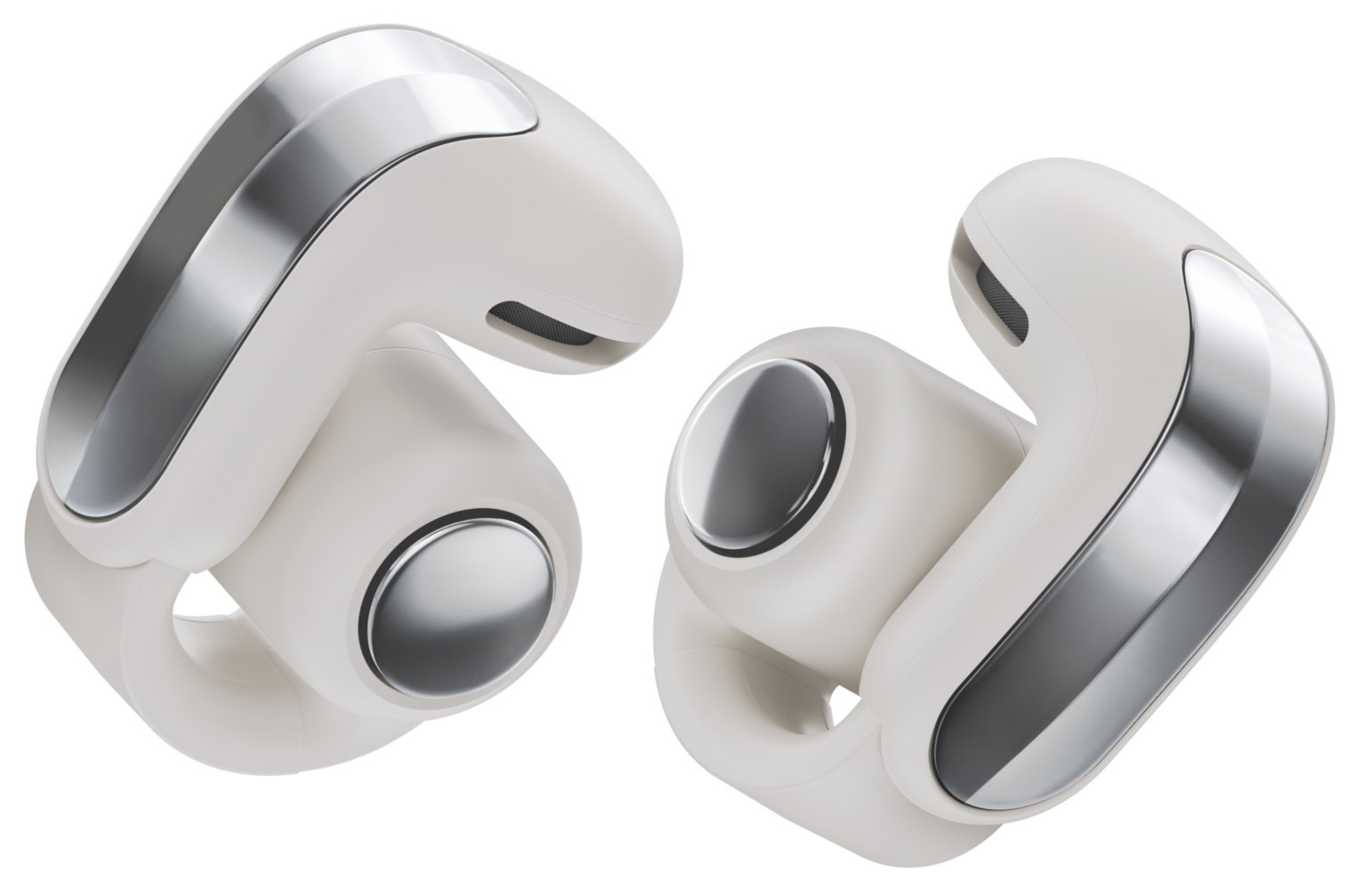
At first glance, not much has changed. The Ultra Open Earbuds (2nd Gen) have that handy combination of function and fashion, and while I’ve not tested a huge number of clip-on earbuds since the original Ultra Open, this model still remains above the competition as far as aesthetics are concerned.
What changes have been made appear subtle. The area with the brushed metallic finish now has a glossy two-tone look, the charging case is slightly bigger and less curved (Bose describes it as more ‘robust’). They’re still rated at IPX4 to protect against water and sweat. Nothing’s really changed that’s impacted the fit or build quality of these headphones.

They fasten around the earlobe with the cuff design, and they remain comfortable to wear over several hours, slipping onto the earlobe with consummate ease. I’ve worn them frequently for half the day at times, and there were points where I forgot I was wearing them. They’re so lightweight that they’re barely noticeable, which might be a good thing or a bad thing.
There have been moments of some discomfort, but that’s mainly been when the weather’s cold and the pinch of the earbuds on a frozen ear is more acute.
The problem that remains with these earbuds is also precisely the point of them – their openness. In quieter environments, they’re able to handle noise around them – Bose has improved the performance in that area, but more on that later.

The open design is a detriment in louder environments because it leaves your ears unprotected from surrounding noise. These are earbuds best suited for indoor use, but in my time with the earbuds, some of the changes Bose has made give them a fighting chance of surviving noisy areas better than the 1st Gen could.
On the battery barrel, as it were, is a physical button that’s held in a pincer movement to control playback. Press to play and pause, double-press to skip tracks, triple-press to go back. To change the volume, press and hold, though, with this control, I’ve not been able to use it as the earbuds power off. Press and hold also works with the Shortcut, presumably disabling volume control.
At the moment, there’s less variety of colours and no two-tone finishes compared to before, at least not yet, with colours consistent across the entirety of the earbuds. For now, there’s a choice of Black, White Smoke, Sky Pink and limited-edition Cherry Chocolate or Olive Green (the sample you see here).

Features
- aptX Adaptive Bluetooth
- Bose app
- Auto Volume
Bluetooth has been boosted to v5.4 with SBC, AAC, and aptX Adaptive (for Android devices) streams. The aptX Adaptive support means these buds also support Snapdragon Sound, which seems a little overkill for earbuds of this nature, but should also forge a solid connection with compatible devices. Even with my non-Snapdragon Sound smartphone, the connection has been robust over the month or so I’ve been using the headphones.
Bluetooth multipoint is supported, so you can connect to two devices at the same time. There’s also Google Fast Pair to connect to multiple Android devices quickly.

The Bose app has had something of a revamp under the hood with the launch of the Lifestyle Collection devices earlier in 2026, but visually the app remains the same. The app is where you can monitor battery life, control volume, adjust EQ settings, customise the Shortcut button and switch from Stereo to the Immersion modes.
With Bose’s TrueSpatial tech, it’s a choice of Still (for sitting down) and Motion (for when you’re moving about).
The Auto Volume feature from the original returns and it has a much greater impact this time around. It adapts the sound in accordance to how loud the environment around you is. When it gets louder, it ups the loudness of audio and when the noise lowers, it dials it back.

Before it wasn’t noticeable but now it very much is. Wearing them in a shuttle bus, it’s noticeable when the loudness gets pushed up and down, but it’s never in your face or distracting. I find the effect subtle, avoiding instances where audio gets ramped up and takes me by surprise. It helps combat outside noise better. It won’t make you forget what’s around you, but it’ll cover it up better.
Call quality is better than the original but still about average. They’re really good at combating background noise. The person on the other end mentioned that they couldn’t hear what was around me, so that’s a positive.

In quiet areas they perform strongly in terms of voice pick-up, but when it gets noisy, voice pick-up becomes muffled and they mentioned there were times where it sounded as if my voice cut out.
That’s not great if you’re using them outside. The other problem is that I find it a struggle to hear what the other person is saying because there’s no protection from noise. Walking around the South Quays area of Canary Wharf, there were points where I really struggled to hear what was said. If you’re going to use these earbuds for calls, better do so inside.
Battery Life
- Close to 30 hours
- Wireless charging support
With the original Ultra Open Earbuds, Bose expected about 7.5 hours (4.5 hours with Immersive Audio).
That’s been boosted to 9 hours with the Ultra Open Earbuds 2nd Gen, with five hours for either Immersive Audio or Auto Volume. It falls to four hours if both those features are on. The case offers another 19.5 hours, so there’s plenty of stamina for these headphones to last.

In the battery drain I carried out, the headphones went on for much longer than I anticipated. A six hour drain at 50% volume saw the earbuds fall to about 45%, which suggests 11 to 12 hours in total – and that’s without enabling Auto Volume or Immersive Audio. Regardless, that’s pretty good going.
Fast charging is supported with ten minutes providing two hours, which is actually worse than before (two minutes for two hours). At least this time around wireless charging is supported from the get-go.
Sound Quality
- Clear mids and highs
- Better bass but still lacking in that department
I mentioned in the Features section that the Auto Volume feature is much more effective, but Bose has also made a change to the loudness of the earbuds themselves. These are much louder in terms of audio at default volumes, and the difference between the 1st Gen and 2nd Gen is almost night and day.
Even at near full volume the Open Ultra Earbuds (1st Gen) would sound so meek. But the boost Bose has given the 2nd Gen at default volume levels produces a better audio experience. And because of that boost, there’s more detail to pick up on without losing it to environmental noise.
That’s not the only solve Bose has brought with the 2nd Gen Ultra Open Earbuds. The tone of these earbuds is a little less tinny and crisp than before. The soundstage has been positioned in a more forward placement, bringing audio closer to your hears, and along with that, bass has been improved.

That said, vocals still carry a slight thinness to them. And if there’s one note that keeps popping up with these earbuds, it’s that the sound lacks weight, but the tuning avoids sounding either clinical or fatiguing. I’ve listened to these headphones for hours, and while they lack a degree of energy and aren’t dynamic in the slightest, the way they carry tunes has kept me listening for several hours.
Treble carries more detail and bit more brightness than before, the original earbuds sound dull and defeated when playing the same tracks. They’re not the brightest, but there is a more natural tone applied to the highs than before when listening to GoGo Penguin’s Erased by Sunlight.
There’s more detail that the 2nd Gen earbuds reveal in the midrange area, and vocals are more nuanced and detailed. Those vocals are a bit small in terms of the space they occupy in the soundstage, but the midrange presentation is aided by the improvements to the earbuds’ loudness.

Bass is still the most qualified aspect of the Ultra Open Earbuds (2nd Gen). The performance on the original was pretty feeble, but now there’s more presence to the low frequencies. That said, there’s not much power, depth, punch or extension they can call upon – so while they’re a more insightful listen than the Shokz OpenFit Pro, they don’t carry the bass energy of those earbuds.
And then there’s the Immersive Audio performance, which is much better here than on the original. Like with stereo music, immersive audio benefits from the increase in loudness. The Immersive Audio mode doesn’t sound as thin as before, and there’s a better sense of that depth to the soundstage and an increase in width.
It’s still not as detailed as the Stereo mode but vocals come clearly. The responsiveness of the head-tracking is good too. It’s a better effort this time around.
Should you buy it?
If you weren’t convinced the first time around
Better sound, better battery life, better implementation of its various features. This is a much more polished open-earbud effort than the original.
The price makes you think twice
They’re really expensive and without some form of noise reduction, I’m feeling that the premium price is a little high.
Final Thoughts
There are sequels that make the original seem worse, and that’s what the Bose Ultra Open Earbuds (2nd Gen) do. It shows that lessons have been learnt and implemented. These are a much better open-earbuds effort than the original.
The Auto Volume is more effective this time around. The battery life has been extended. The loudness of the sound offers a better presentation of audio, while the design remains comfortable and wireless performance is strong.
Call quality is better but there are still struggles taking calls in louder environments. Really, these are earbuds are best served by using them indoors than on the commute. The open nature of the design doesn’t work in its favour when outside, even though Bose has given these earbuds a better chance at withstanding that noise.
They’re also rather expensive at £299 / $299. Bose is all about providing a ‘premium’ experience, but the price is a lot compared to the performance of Bose’s own QuietComfort Ultra Earbuds (2nd Gen). They’re not comparable, but Bose’s pricing invites comparisons nonetheless.
The Bose Ultra Open Earbuds (2nd Gen) are best suited as a sidekick to your main pair of headphones rather than as your main pair. But the improvements made have resulted in a better all-round performance, and while there’s still a few areas of improvement, Bose has inched further in making clip-on earbuds a more practical solution for outdoor use. Though I’d love to see Bose release an open-earbud design with noise reduction…
How we test
The Bose Ultra Open Earbuds (2nd Gen) were tested over the course of a month with real world use.
Calls both indoors and out were taken on the earbuds, a battery drain was carried out, and the performance compared to the original model
- Tested with real world use
- Tested for a month
- Battery drain carried out
Full Specs
| Bose Ultra Open Earbuds (2nd Gen) Review | |
|---|---|
| Manufacturer | Bose |
| IP rating | IPX4 |
| Battery Hours | 28.5 |
| Wireless charging | Yes |
| Fast Charging | Yes |
| Release Date | 2026 |
| Audio Resolution | SBC, AAC, apX Adaptive |
| Connectivity | Bluetooth 5.4 |
| Colours | Black, White Smoke, Sky Pink, limited-edition Cherry Chocolate, Olive Green |
| Frequency Range | – Hz |
| Headphone Type | On-ear (Open) |
| UK RRP | £299 |
| USA RRP | $299 |