

For decades, scoliosis treatment has existed at the intersection of art and science. While bracing has proven effective in preventing curve progression and reducing the need for surgery, outcomes have historically depended heavily on practitioner experience, subjective decision making, and inconsistent manufacturing methods. Today, that paradigm is changing.
After more than thirty five years in clinical practice, fitting thousands of children and adolescents with every major scoliosis brace ever developed, Glenn Easton has led what many now recognize as one of the most significant medical and technical breakthroughs in non operative scoliosis treatment.
Easton’s journey was not rooted in theory alone. It was forged through decades of hands on clinical experience, constant refinement, and a relentless commitment to improving outcomes while preserving childhood quality of life. Having personally witnessed the physical and emotional burden that surgery can impose on children and families, Easton has always maintained a clear and principled stance. Surgery remains a necessary tool in severe cases, but it should be the last option. Every viable non operative intervention must be exhausted before a child is placed under the knife.
From Classification and Therapy to Precision Engineering
Easton’s clinical philosophy is grounded in the most respected scoliosis frameworks in the world. His brace designs integrate the teachings of Dr Manuel Rigo and the Rigo classification system, widely regarded as the gold standard for three dimensional scoliosis analysis. Equally foundational is the incorporation of Schroth therapy principles, emphasizing rotational breathing, postural awareness, and neuromuscular reeducation.
Despite mastering these methodologies and achieving strong results with traditional fabrication methods, Easton recognized a critical limitation. Even the most skilled orthotist could not consistently reproduce identical outcomes using conventional brace manufacturing. Variability in plaster casting, hand modification, material behavior, and subjective interpretation created unavoidable inconsistencies.
Easton reached a pivotal realization. To deliver predictable, repeatable, and measurable outcomes at scale, scoliosis bracing needed technology. Not incremental improvement, but a complete reimagining of how braces are designed, analyzed, and produced.
The Birth of Scoli3D
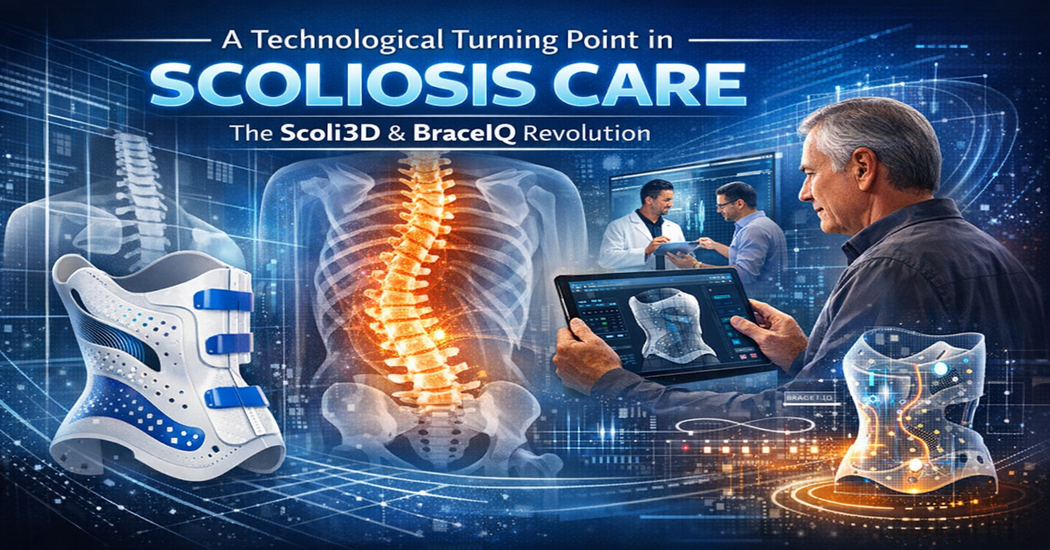
This realization led to the development of the Scoli3D brace system. Unlike traditional braces, Scoli3D is not simply a device. It is the physical output of a highly engineered digital workflow that captures, analyzes, and responds to the patient’s anatomy in three dimensions.
Scoli3D braces are designed using advanced CAD CAM techniques refined by Easton over decades. Each brace is digitally sculpted to address coronal deviation, sagittal alignment, and axial rotation simultaneously. The goal is not immobilization, but guided correction that works with the patient’s physiology and respiratory mechanics.
Yet even with this advancement, Easton knew that hardware alone was not enough.
A Global Collaboration and the Creation of BraceIQ
While traveling in Asia in pursuit of advanced additive manufacturing technologies, Easton encountered the partners who would help propel scoliosis care into its next era.
Bardia Alizadeh, with a background in kinesiology, brought a deep understanding of biomechanics, human movement, and corrective forces. William Pan, a software architect and advanced 3D printing engineer, contributed expertise in algorithm driven design and industrial scale manufacturing.
Together, they assembled an elite global team of artificial intelligence engineers, data scientists, and software developers from Dubai, China, Vancouver, and the United States. Their mission was ambitious but clear. Transform decades of clinical expertise into an intelligent, scalable, and measurable digital platform.
The result was BraceIQ.
BraceIQ – The Intelligence Behind the Brace
BraceIQ is not a design tool. It is an intelligent clinical ecosystem.
At its core, BraceIQ converts patient specific data into actionable, outcome driven brace designs. The software ingests three dimensional scans, clinical measurements, and soon, EOS low dose biplanar X ray imaging directly into its system. Glenn Easton is currently collaborating with EOS imaging engineers to integrate radiographic data seamlessly into the BraceIQ workflow, allowing unprecedented alignment between skeletal anatomy and orthotic correction.
BraceIQ analyzes Cobb angle, axial rotation, sagittal balance, and curve pattern simultaneously. Unlike traditional methods that rely on static snapshots, the platform models correction dynamically, accounting for growth, compliance, and biomechanical response.
One of BraceIQ’s most groundbreaking capabilities is its integration with ScoliSense compliance sensors. These embedded sensors objectively track wear time, temperature, and usage patterns. This data feeds directly back into BraceIQ, allowing clinicians to correlate real world compliance with three dimensional outcomes.

For the first time in scoliosis care, practitioners can answer questions that were previously impossible to quantify. How many hours of wear are required to achieve a specific correction? How does axial rotation respond over time? How does compliance variability impact long term outcomes?
BraceIQ enables the creation of large scale, data driven studies on scoliosis correction, moving the field away from anecdotal evidence and toward measurable, reproducible science.
Redefining the Future of Orthotics and Prosthetics
While BraceIQ was developed to power Scoli3D, its vision extends far beyond scoliosis alone. The board at BraceIQ plans to deploy the platform globally, allowing qualified practitioners to design and manufacture a wide range of orthotic and prosthetic devices with unprecedented precision.
By standardizing intelligence while preserving clinical autonomy, BraceIQ has the potential to elevate the entire profession. Experienced clinicians can embed their knowledge into digital workflows, while newer practitioners gain access to systems that dramatically reduce variability and error.
This is not automation replacing clinicians. It is technology amplifying expertise.
A New Standard of Care
The convergence of Scoli3D and BraceIQ represents a fundamental shift in how scoliosis is treated. It replaces intuition with intelligence, variability with consistency, and guesswork with data. Most importantly, it gives children a better chance to avoid surgery, preserve mobility, and live without unnecessary physical or emotional burden.
Glenn Easton’s work stands as a testament to what happens when clinical mastery meets technological vision. After decades of trial, refinement, and relentless dedication, scoliosis care is entering a new era. One defined not by tradition, but by precision, accountability, and measurable outcomes.
This is not simply an advancement. It is a turning point scoliosis patient care.