


The premium area of the true wireless market is competitive, and the Philips Fidelio T1 aren’t quite up to the level of their closest rivals. While they hit the mark on the sound front, the design is cumbersome and may cause some a degree of discomfort, and there are more effective noise-cancelling earphones available.
Pros
- Stylish looks
- Entertaining sound
- Good connectivity
Cons
- Bulky, not the most comfortable
- Susceptible to sound leakage
- Better noise cancellers for less money
- Battery doesn’t last as long as claimed
- App could be more comprehensive
Availability
- UKRRP: £249.99
- USATBC
- EuropeTBC
- CanadaTBC
- AustraliaTBC
-
Google Fast PairQuick first-time pairing with Android devices -
Adaptive ANCCan adapt ANC performance on the fly -
BluetoothSupports Bluetooth 5.2 with SBC, AAC and LDAC codecs
Introduction
Following years in the darkness of licensing limbo, Philips’ Fidelio audio branch has risen to its former standing, the sunlight visible as it jostles for position in the audio market.
Clearly I’ve been watching too many David Attenborough nature shows with that verbose intro, but like the ecosystems of the Green Planet, the return of Fidelio owed much to resilience and adaptation. The likes of the Fidelio X3 and L3 have shown there’s a place for Philips at the top end of the market.
The T1 are the first true wireless earphones birthed from the Fidelio range, combining Philips’ high-end European design and audio sensibility. But there are a lot of true wireless vying for the same space, so can Philips plant some deep roots?
Design
- Large and bulky case/earbuds
- Lots of ear-tips provided
- Not the most comfortable
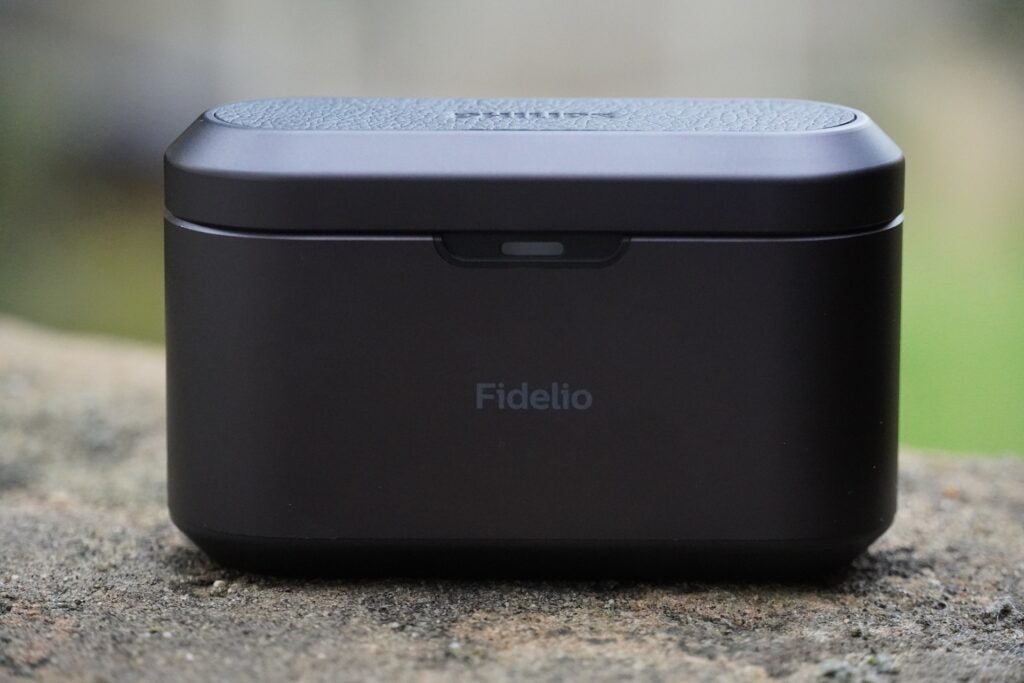
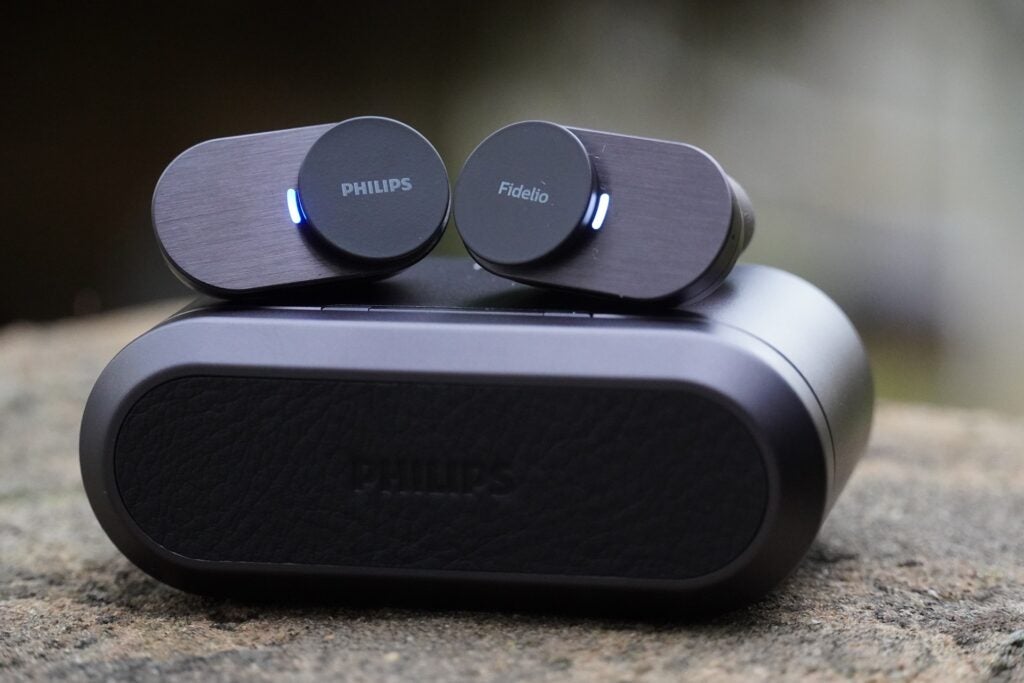
I can’t not talk about the size of the Fidelio T1’s case and earbuds – both are bigger than expected. The cool (in terms of temperature), machined finish of the case brings class to proceedings, and the Muirhead leather that adorns the case’s top surface is a nice touch – quite literally. But for tight jean pockets, the case’s largesse is a sticking point.
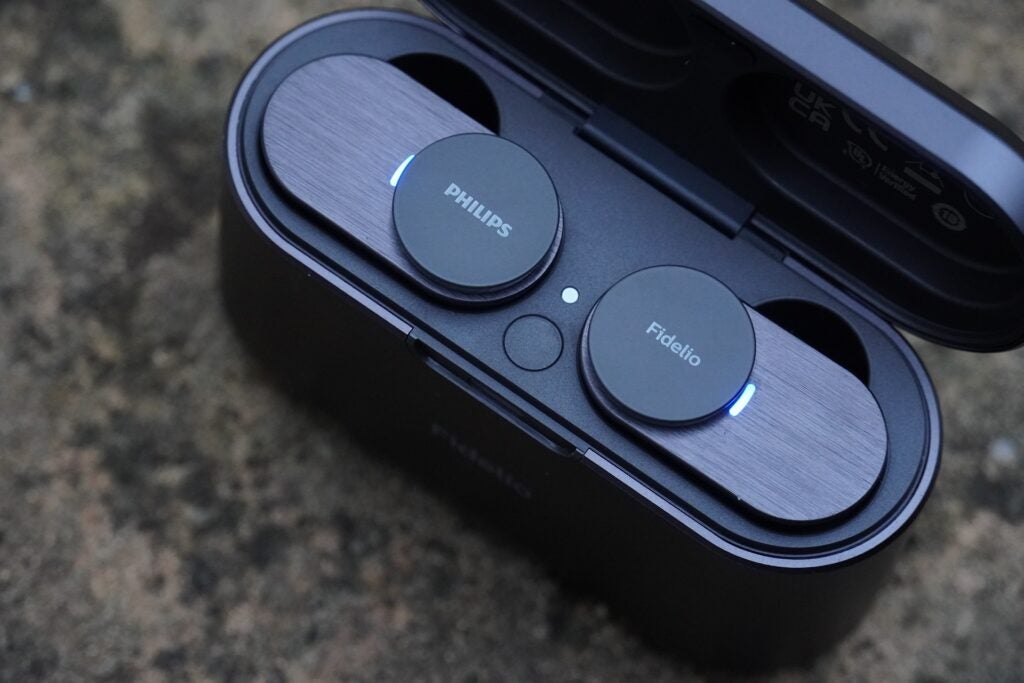
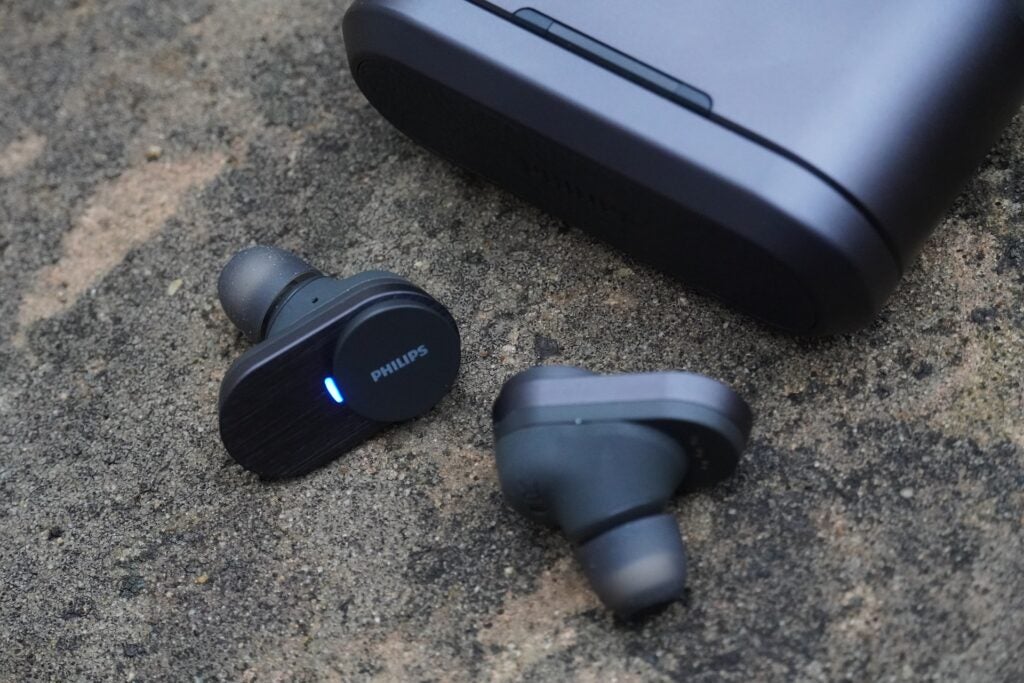
In addition, the earbuds’ design is out of step with recent trends. True wireless buds have become more compact, and it would seem the Fidelio T1 have taken inspiration from Sony’s three-year-old WF-1000XM3. They’re undoubtedly swish in appearance; Philips has incorporated its own aesthetic with the rounded touch panels and elegantly smooth finish. On the surface, they look great.
But like an iceberg, the area below water is more… substantial. The size of the T1’s housing is big, and it resulted in a few problems when attempting to insert them. The manual describes the fit as a simple twist and lock, but I found it took a while to get a fit that felt somewhat right; there was a lot of twisting and wiggling going on, too much really.
Following a few days of experimenting, I found a solution that sort of worked – although I’m not wholly confident it’s the most optimal. The amount of leakage suggests the fit could be better, and I didn’t find them to be the most comfortable either. A slight ache emerged in the tragus and antitragus region of the ear following about 20 minutes of wear. The Fidelio T1 constantly reminded me of their presence, and there were times when taking them out was a relief.
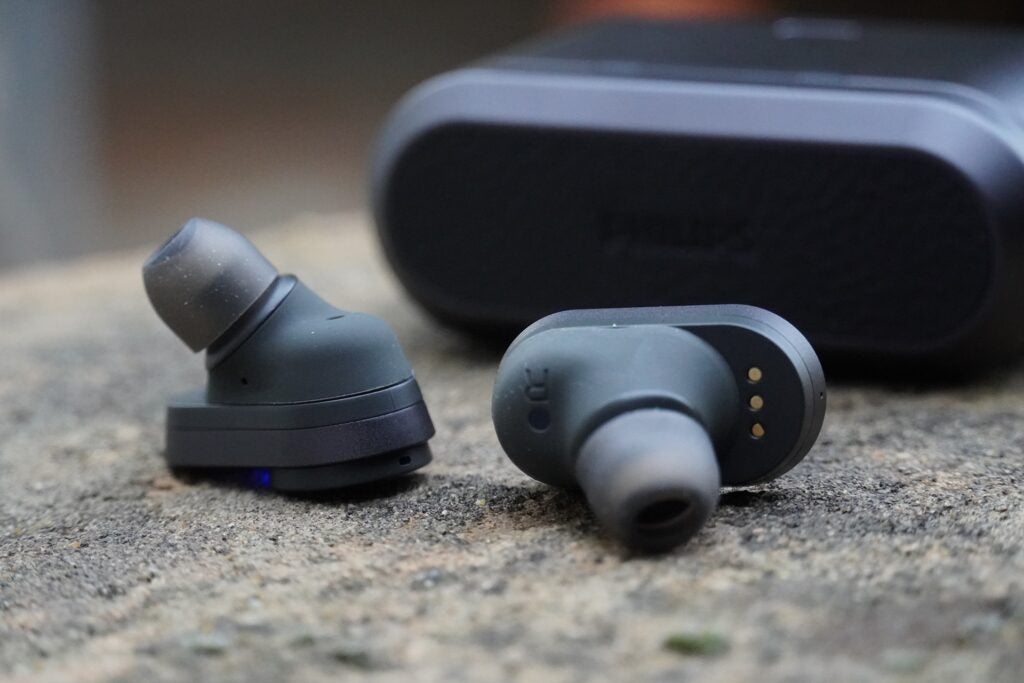
I’d have more confidence had the Fidelio T1 made use of an in-app, ear-fit tip test. Nevertheless, at least there’s an abundance of choice for finding a less irksome fit, with six rubber ear-tips and three Comply foam tips packaged among the accessories.
Features
- Decent noise cancellation
- Ambitious battery life claims
- Touch controls are incomplete
On paper, the quoted stamina of 9 and 25 hours with noise cancellation (34 in total) would be class-leading at this price. And even more impressive is 13 and 35 hours without ANC (for a total of 48).
In the real world those figures don’t add up, though, at least with LDAC and ANC on. The Fidelio T1 ate through their reserves like Pac-Man eats dots – three hours of use at around medium volume level landed the buds at 50%. Charging from dead to full battery via USB-C takes two hours; wireless charging takes four (which makes you wonder why you’d even bother); a 15-minute charge offers two hours of playback.
Noise-cancelling performance is fair, I’d say, but very dependent on achieving the right fit and finessing the volume to dispel most sounds. At normal listening levels there remains some leakage; but for the most part, low-frequency sounds are removed. Persistent ambient sounds, such as the hum of air conditioning on a train, are reduced significantly, engine noise from vehicles is squashed, and voices are minimised.
The T1 aren’t as good at dealing with high frequencies – in some cases, the screech of a train or the sound of wet tyres on a road were amplified. The nature of the fit also led to the earbuds pushing out when moving my head or walking, so the seal attained was never a constant one. I can see that with the right fit they would be capable of clearing more noise, but that wasn’t the case for me.
The Wind Reduction mode does make gusts less of concern, although the ‘Low’ ANC mode hardly seems worth bothering with; it lets a little more noise pass through. The Philips are proficient enough at dispelling sounds, but not to the extent of Bose, Sennheiser and Sony.
The Awareness mode allows the outside world in, and while voices are handled fine, it’s slightly less natural in tone than others. In busy areas it can amplify all noises all at once, which feels like a flood of sound hitting you at once. Other modes include Quick Awareness, which lowers the volume when the right earbud is pressed and held, while Adaptive figures out what you’re doing and changes the noise cancelling on-the-fly.

There’s voice assistant support but it isn’t built in, and therefore isn’t hands-free; a two-second press on the left bud brings up the default assistant. Touch controls can be a tad inconsistent – a triple-tap to skip to the next track often resulted in cycling through the noise-cancelling modes instead – and they’re incomplete.
Music can be paused and skipped forward but not skipped back, there’s no means of adjusting the volume onboard, and no means of customising the controls, which is a slight disappointment.
The wear sensor works fine: it’s quicker to resume than it is to stop, but nothing that’s particularly problematic. The Philips Headphones app shows the info you’d need in terms of battery life, playback and streaming codecs (SBC, AAC and LDAC are supported).
In the app Ambient Control can be toggled off as can Multi-Connection (for connecting to two devices at once), Default Voice Assistant, Wear Sensor, Touchpad, and Sidetone (for hearing your own voice during calls).
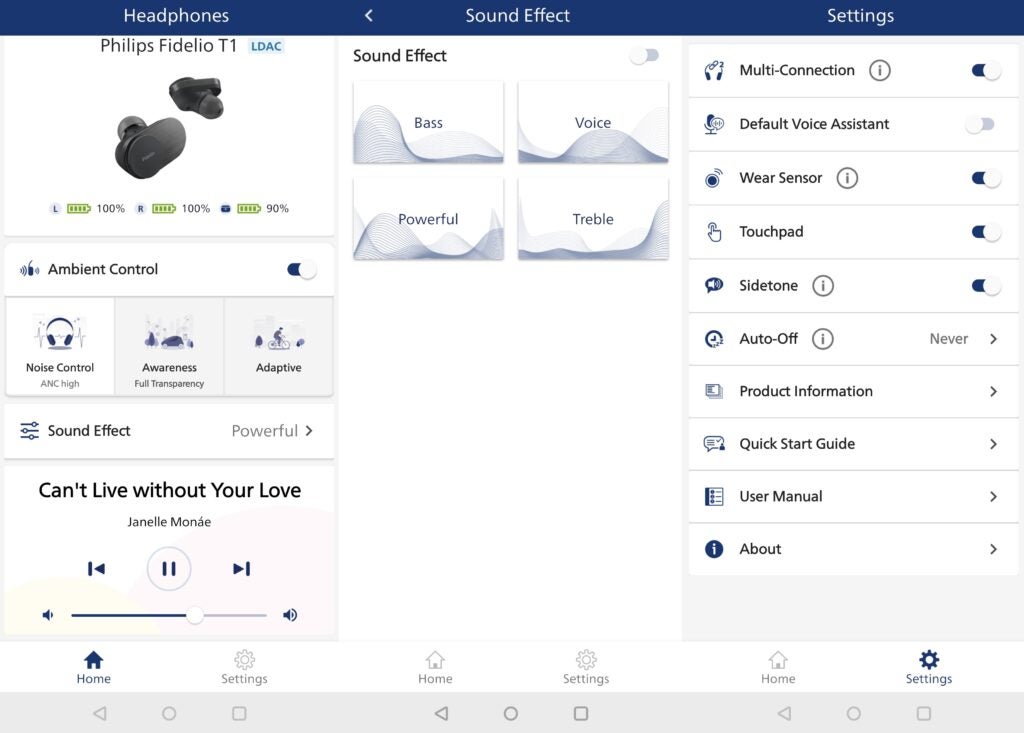
The built-in equalizer only offers four presets (Bass, Voice, Powerful and Treble), of which I found Powerful to be the most useful; but it doesn’t exactly live up to the name. Voice isn’t too bad, but in focusing on vocals other instrumentation is obscured, which isn’t great when backing vocals kick in.
Bass brings about a thicker, more resonant low-end, while the Treble setting adds more presence and definition to high frequencies without affecting those below. Disappointingly, there’s no means of creating your own EQ, so it’s a take it or leave situation.
Bluetooth 5.2 connectivity equips itself creditably in populous areas; a few stutters but nothing irksome. Call quality can struggle on windy days, and like the Ambient mode, the Fidelio T1’s 3-mic set-up for calls can amplify background sounds. In normal conditions, this wasn’t to the point where voices were smothered, but in windy weather the person on the other end found it a struggle to hear what I was saying.
Sound Quality
- Up against strong competition
- Good clarity and detail
- Solid rhythmic skills
As someone who found the Fidelio T1’s fit temperamental at best, I’d surmise there’s a little potential left on the table where sound is concerned. If the T1 fit your ears better, you’ll likely have a more positive impression.
The soundstage is a smidge smaller in scope than either the Sennheiser Momentum True Wireless 3 or Sony WF-1000XM4, but it’s still wide and solidly defined, with a slight richness to its tone. Bass depth is effectively parlayed in Billie Eilish’s xanny, satisfyingly rumbly in the track’s opening moments, and then punchy and assertive throughout the runtime.
It’s a weighty-sounding performance, but not to the point where detail is missing, or the frequency range feels out of balance. The mid-range is described in fairly incisive terms, with very good clarity on vocals such as Anette Askvik’s Liberty, where every cadence and change in pitch of her voice is described with fine fidelity.
With a track such as the Pharcyde’s Runnin’, the Fidelio T1 ensure the fast rhymes are smooth and intelligible, while I can just about hear what the Beastie Boys are saying in Sabotage. A nit-pick is that voices could be brought further forward to distinguish them from other elements to afford them some more breathing space. The Voice EQ does this in a way, but tonally it sounds a little off.
Towards the top-end of the frequency range the Fidelio T1 are expressive, although that claimed frequency range of 7-40000Hz seems adventurous. Treble is treated with clarity, but the T1 aren’t the most stand-out in GoGo Penguin’s Raven, and the string instruments in Jonny Greenwood’s HW/Hope of New Fields from There Will be Blood are relayed richly and with detail – although I did find the Sony to be more expressive and boasting more finesse.
The T1 are a more than credible pair in keeping pace and timing when listening to French drummer Manu Katché’s Keep On Trippin – cymbal crashes are crisply described, percussive instruments have good kick to them – while the changes in speed like in System of A Down’s Radio/Video are handled fine. However, more fast-paced transitions lack a degree of explosiveness. Moving from quiet to loud (and vice versa), the T1 are effective, describing the ascending drum beat that opens the Clash’s I Fought the Law; but, again, the Sony stand out more to me in this respect. A fine listen, then, but not the best.
Latest deals
Should you buy it?
If you like Philips’ approach to sound The Fidelio T1 have a rich-sounding, expressive approach to audio that’s consistent with previous efforts in the Fidelio range.
If you want a comfortable fit The bulky design of the Fidelio T1 didn’t mould itself to my ears, which led to a less than comfortable fit and some leakage of sound.
Final Thoughts
I’ve been through a few trials and tribulations with the Fidelio T1. The first sample didn’t want to work with the app, and then there’s the bothersome design. The Fidelio T1 have potential, but in a number of areas they don’t wholly fulfil it.
With the right fit the noise cancellation and Awareness modes work, but there are more effective models available. The battery life isn’t as lengthy as Philips claims, and the app could be more fully featured. It takes some fiddling to get the most out of the Fidelio T1 – and even then, the competition still outguns them.
How we test
We test every headphones we review thoroughly over an extended period of time. We use industry standard tests to compare features properly. We’ll always tell you what we find. We never, ever, accept money to review a product.
Find out more about how we test in our ethics policy.
Tested for more than a week
Tested with real world use
Tested with a range of music genres
FAQs
No, the Fidelio T1 don’t support aptX, but they do support LDAC which presents the opportunity of listening to higher quality music.
Jargon buster
LDAC
LDAC is an audio technology from Sony that allows for higher quality audio streaming over a Bluetooth connection, with bit-rates of up to 990kbps
Bluetooth
Bluetooth – named after 10th-century Danish king Harald Bluetooth who united Denmark’s tribes into a single kingdom – is a method of wireless transmission that allows for the exchange of data between devices over short distances.
ANC
ANC (Active Noise Cancellation) uses an array of microphones in a headphone to detect the frequency of the sound coming at the listener, with the ANC chip creating an inverse wave (i.e. opposing sound) to suppress any unwanted external noises.

The premium area of the true wireless market is competitive, and the Philips Fidelio T1 aren’t quite up to the level of their closest rivals. While they hit the mark on the sound front, the design is cumbersome and may cause some a degree of discomfort, and there are more effective noise-cancelling earphones available.
Pros
- Stylish looks
- Entertaining sound
- Good connectivity
Cons
- Bulky, not the most comfortable
- Susceptible to sound leakage
- Better noise cancellers for less money
- Battery doesn’t last as long as claimed
- App could be more comprehensive
Availability
- UKRRP: £249.99
- USATBC
- EuropeTBC
- CanadaTBC
- AustraliaTBC
-
Google Fast PairQuick first-time pairing with Android devices -
Adaptive ANCCan adapt ANC performance on the fly -
BluetoothSupports Bluetooth 5.2 with SBC, AAC and LDAC codecs
Introduction
Following years in the darkness of licensing limbo, Philips’ Fidelio audio branch has risen to its former standing, the sunlight visible as it jostles for position in the audio market.
Clearly I’ve been watching too many David Attenborough nature shows with that verbose intro, but like the ecosystems of the Green Planet, the return of Fidelio owed much to resilience and adaptation. The likes of the Fidelio X3 and L3 have shown there’s a place for Philips at the top end of the market.
The T1 are the first true wireless earphones birthed from the Fidelio range, combining Philips’ high-end European design and audio sensibility. But there are a lot of true wireless vying for the same space, so can Philips plant some deep roots?
Design
- Large and bulky case/earbuds
- Lots of ear-tips provided
- Not the most comfortable
I can’t not talk about the size of the Fidelio T1’s case and earbuds – both are bigger than expected. The cool (in terms of temperature), machined finish of the case brings class to proceedings, and the Muirhead leather that adorns the case’s top surface is a nice touch – quite literally. But for tight jean pockets, the case’s largesse is a sticking point.
In addition, the earbuds’ design is out of step with recent trends. True wireless buds have become more compact, and it would seem the Fidelio T1 have taken inspiration from Sony’s three-year-old WF-1000XM3. They’re undoubtedly swish in appearance; Philips has incorporated its own aesthetic with the rounded touch panels and elegantly smooth finish. On the surface, they look great.
But like an iceberg, the area below water is more… substantial. The size of the T1’s housing is big, and it resulted in a few problems when attempting to insert them. The manual describes the fit as a simple twist and lock, but I found it took a while to get a fit that felt somewhat right; there was a lot of twisting and wiggling going on, too much really.
Following a few days of experimenting, I found a solution that sort of worked – although I’m not wholly confident it’s the most optimal. The amount of leakage suggests the fit could be better, and I didn’t find them to be the most comfortable either. A slight ache emerged in the tragus and antitragus region of the ear following about 20 minutes of wear. The Fidelio T1 constantly reminded me of their presence, and there were times when taking them out was a relief.
I’d have more confidence had the Fidelio T1 made use of an in-app, ear-fit tip test. Nevertheless, at least there’s an abundance of choice for finding a less irksome fit, with six rubber ear-tips and three Comply foam tips packaged among the accessories.
Features
- Decent noise cancellation
- Ambitious battery life claims
- Touch controls are incomplete
On paper, the quoted stamina of 9 and 25 hours with noise cancellation (34 in total) would be class-leading at this price. And even more impressive is 13 and 35 hours without ANC (for a total of 48).
In the real world those figures don’t add up, though, at least with LDAC and ANC on. The Fidelio T1 ate through their reserves like Pac-Man eats dots – three hours of use at around medium volume level landed the buds at 50%. Charging from dead to full battery via USB-C takes two hours; wireless charging takes four (which makes you wonder why you’d even bother); a 15-minute charge offers two hours of playback.
Noise-cancelling performance is fair, I’d say, but very dependent on achieving the right fit and finessing the volume to dispel most sounds. At normal listening levels there remains some leakage; but for the most part, low-frequency sounds are removed. Persistent ambient sounds, such as the hum of air conditioning on a train, are reduced significantly, engine noise from vehicles is squashed, and voices are minimised.
The T1 aren’t as good at dealing with high frequencies – in some cases, the screech of a train or the sound of wet tyres on a road were amplified. The nature of the fit also led to the earbuds pushing out when moving my head or walking, so the seal attained was never a constant one. I can see that with the right fit they would be capable of clearing more noise, but that wasn’t the case for me.
The Wind Reduction mode does make gusts less of concern, although the ‘Low’ ANC mode hardly seems worth bothering with; it lets a little more noise pass through. The Philips are proficient enough at dispelling sounds, but not to the extent of Bose, Sennheiser and Sony.
The Awareness mode allows the outside world in, and while voices are handled fine, it’s slightly less natural in tone than others. In busy areas it can amplify all noises all at once, which feels like a flood of sound hitting you at once. Other modes include Quick Awareness, which lowers the volume when the right earbud is pressed and held, while Adaptive figures out what you’re doing and changes the noise cancelling on-the-fly.
There’s voice assistant support but it isn’t built in, and therefore isn’t hands-free; a two-second press on the left bud brings up the default assistant. Touch controls can be a tad inconsistent – a triple-tap to skip to the next track often resulted in cycling through the noise-cancelling modes instead – and they’re incomplete.
Music can be paused and skipped forward but not skipped back, there’s no means of adjusting the volume onboard, and no means of customising the controls, which is a slight disappointment.
The wear sensor works fine: it’s quicker to resume than it is to stop, but nothing that’s particularly problematic. The Philips Headphones app shows the info you’d need in terms of battery life, playback and streaming codecs (SBC, AAC and LDAC are supported).
In the app Ambient Control can be toggled off as can Multi-Connection (for connecting to two devices at once), Default Voice Assistant, Wear Sensor, Touchpad, and Sidetone (for hearing your own voice during calls).
The built-in equalizer only offers four presets (Bass, Voice, Powerful and Treble), of which I found Powerful to be the most useful; but it doesn’t exactly live up to the name. Voice isn’t too bad, but in focusing on vocals other instrumentation is obscured, which isn’t great when backing vocals kick in.
Bass brings about a thicker, more resonant low-end, while the Treble setting adds more presence and definition to high frequencies without affecting those below. Disappointingly, there’s no means of creating your own EQ, so it’s a take it or leave situation.
Bluetooth 5.2 connectivity equips itself creditably in populous areas; a few stutters but nothing irksome. Call quality can struggle on windy days, and like the Ambient mode, the Fidelio T1’s 3-mic set-up for calls can amplify background sounds. In normal conditions, this wasn’t to the point where voices were smothered, but in windy weather the person on the other end found it a struggle to hear what I was saying.
Sound Quality
- Up against strong competition
- Good clarity and detail
- Solid rhythmic skills
As someone who found the Fidelio T1’s fit temperamental at best, I’d surmise there’s a little potential left on the table where sound is concerned. If the T1 fit your ears better, you’ll likely have a more positive impression.
The soundstage is a smidge smaller in scope than either the Sennheiser Momentum True Wireless 3 or Sony WF-1000XM4, but it’s still wide and solidly defined, with a slight richness to its tone. Bass depth is effectively parlayed in Billie Eilish’s xanny, satisfyingly rumbly in the track’s opening moments, and then punchy and assertive throughout the runtime.
It’s a weighty-sounding performance, but not to the point where detail is missing, or the frequency range feels out of balance. The mid-range is described in fairly incisive terms, with very good clarity on vocals such as Anette Askvik’s Liberty, where every cadence and change in pitch of her voice is described with fine fidelity.
With a track such as the Pharcyde’s Runnin’, the Fidelio T1 ensure the fast rhymes are smooth and intelligible, while I can just about hear what the Beastie Boys are saying in Sabotage. A nit-pick is that voices could be brought further forward to distinguish them from other elements to afford them some more breathing space. The Voice EQ does this in a way, but tonally it sounds a little off.
Towards the top-end of the frequency range the Fidelio T1 are expressive, although that claimed frequency range of 7-40000Hz seems adventurous. Treble is treated with clarity, but the T1 aren’t the most stand-out in GoGo Penguin’s Raven, and the string instruments in Jonny Greenwood’s HW/Hope of New Fields from There Will be Blood are relayed richly and with detail – although I did find the Sony to be more expressive and boasting more finesse.
The T1 are a more than credible pair in keeping pace and timing when listening to French drummer Manu Katché’s Keep On Trippin – cymbal crashes are crisply described, percussive instruments have good kick to them – while the changes in speed like in System of A Down’s Radio/Video are handled fine. However, more fast-paced transitions lack a degree of explosiveness. Moving from quiet to loud (and vice versa), the T1 are effective, describing the ascending drum beat that opens the Clash’s I Fought the Law; but, again, the Sony stand out more to me in this respect. A fine listen, then, but not the best.
Latest deals
Should you buy it?
If you like Philips’ approach to sound The Fidelio T1 have a rich-sounding, expressive approach to audio that’s consistent with previous efforts in the Fidelio range.
If you want a comfortable fit The bulky design of the Fidelio T1 didn’t mould itself to my ears, which led to a less than comfortable fit and some leakage of sound.
Final Thoughts
I’ve been through a few trials and tribulations with the Fidelio T1. The first sample didn’t want to work with the app, and then there’s the bothersome design. The Fidelio T1 have potential, but in a number of areas they don’t wholly fulfil it.
With the right fit the noise cancellation and Awareness modes work, but there are more effective models available. The battery life isn’t as lengthy as Philips claims, and the app could be more fully featured. It takes some fiddling to get the most out of the Fidelio T1 – and even then, the competition still outguns them.
How we test
We test every headphones we review thoroughly over an extended period of time. We use industry standard tests to compare features properly. We’ll always tell you what we find. We never, ever, accept money to review a product.
Find out more about how we test in our ethics policy.
Tested for more than a week
Tested with real world use
Tested with a range of music genres
FAQs
No, the Fidelio T1 don’t support aptX, but they do support LDAC which presents the opportunity of listening to higher quality music.
Jargon buster
LDAC
LDAC is an audio technology from Sony that allows for higher quality audio streaming over a Bluetooth connection, with bit-rates of up to 990kbps
Bluetooth
Bluetooth – named after 10th-century Danish king Harald Bluetooth who united Denmark’s tribes into a single kingdom – is a method of wireless transmission that allows for the exchange of data between devices over short distances.
ANC
ANC (Active Noise Cancellation) uses an array of microphones in a headphone to detect the frequency of the sound coming at the listener, with the ANC chip creating an inverse wave (i.e. opposing sound) to suppress any unwanted external noises.