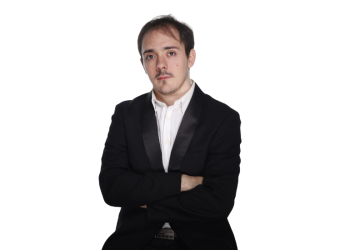






“He doesn’t like talking about himself,” Marja Kantola-Panula said, gesturing to her husband, Jorma Panula, across their dining table while he sat silently. He had been asked a question about his sprawling presence in classical music as arguably the world’s most influential conducting teacher. But instead of answering, he took a bite from a pastry.
When Panula, 93, does speak, it’s brief and authoritative, at times abrasive and absolutely clear. At his home, a modest yet paradisiacal retreat tucked among trees in the countryside northwest of Helsinki, he explained, “I was in the orchestra, and most musicians, they hate talking.”
He is not so different in the classroom, where he is famous for quietly listening, happy to offer advice if students ask for it but otherwise saying little, gruffly, and certainly never lecturing. His approach hasn’t really changed in the half-century he has spent shaping young conductors — at the storied Sibelius Academy in Helsinki, and now through master classes and his own school.
Think of major Finnish conductors working around the world today — there are a disproportionate number of them — and chances are they studied with Panula. If this country is the world’s top exporter of conducting talents, then he is something like a farmer, cultivating generations of artists: those leading the field, like Susanna Mälkki and Esa-Pekka Salonen, and those emerging in a blaze, like Klaus Mäkelä.
“None of us would exist without him,” said Tarmo Peltokoski, the 23-year-old Finn who leads the Latvian National Symphony Orchestra. “All the foundation of my conducting comes from him.”
Peltokoski in particular has a close relationship with Panula because of their shared background: Both grew up in Vaasa, in western Finland, and speak its dialect. It’s there that Panula hosts a conducting competition every three years. But it’s not where he first picked up a baton; he had prepared for a different life, one that led to his graduating, in 1950, from the Sibelius Academy as a student of organ and church music.
That school is the namesake of Jean Sibelius, Finland’s most treasured composer, who was still alive, and in his 80s, when Panula moved to Helsinki. One day, a friend told him where the national hero liked to take a walk after lunch. “The next morning, it was rainy, but I took my bicycle to the little bay and waited,” Panula recalled. “It was freezing, and I waited, and waited. He didn’t come, so I went back home.”
Later, that afternoon, he ran into a neighbor, who said that Sibelius had arrived right after he left. “Mamma mia!” Panula exclaimed, throwing up his hands in exasperation from a rocking chair in his living room seven decades later. “I was so close.” The two never met.
Panula remained at the Sibelius Academy to study conducting, which he decided to focus on as a career, with success: By 1965, he was the music director of the Helsinki Philharmonic. His tenure was thoroughly Finnish, with repertoire heavy on homegrown composers, but also pioneering in his commitment to works by, for example, Shostakovich. He composed music as well, for both the concert hall and the opera house.
His career as a conductor, however, pales compared with his teaching.
Most of Panula’s students begin at a young age, though not always. Dalia Stasevska, 38, the chief conductor of the Lahti Symphony Orchestra, didn’t start until her early 20s. She played violin in a Sibelius Academy ensemble that he used in his classes. After seeing Eva Ollikainen (now of the Iceland Symphony Orchestra) at the podium one session, Stasevska told Panula that she was interested in conducting, so he took a receipt out of his pocket, wrote a phone number on it and said, “Call here.” She was so inspired by her first experiences with him, she said, “I couldn’t let go of the baton from my hands.”
Mäkelä, 27, and Peltokoski were both adolescents with no conducting experience when they enrolled in Panula’s classes, and they studied with him until adulthood. They got a crash course in his quintessentially Finnish school of thought, which Sakari Oramo, 57, a former student of Panula’s who now teaches at the Sibelius Academy, summarized by saying: “You have to be able to express everything with just your hands. We are a nation of few words.”
And so, at least at first, Panula’s students are not allowed to speak while they conduct. They do communicate physically, though. Mäkelä recalled that he was never taught the basic patterns of gesturing time — something easy enough, an actor can pick it up for a role — but that he was immediately made to lead musicians with small movements, just “a postage-stamp-sized beat.” Once that was accomplished, he added, “we could do whatever we wanted.”
“Clarity,” Panula said, “is No. 1, fundamental.”
Very quickly, the reasoning behind his lessons becomes clear. To Peltokoski, Panula’s approach to communication set up how to interact with players efficiently, and honestly, to “not suck up to anyone.” And Mäkelä has since noticed how easily conductors develop mannerisms that his education resisted.
Panula values close readings of scores, which to him entail more than simply following the notes on the page. “I can see in their faces if they know the music or not,” he said, which means also knowing a composer’s particular style, as well as background. “What kind of literature were they reading?” he added as an example. “What opera did they see? What ballet?”
He often proposes questions without offering answers, Mäkelä said, which makes it “so much more powerful when you find the answer yourself.” If students want more detailed explanations from him, however, he won’t deny them. “They can always ask,” Kantola-Panula said. “The best students will do that.”
This method also avoids a pitfall in conducting pedagogy: creating clones. Rather, Oramo said, he “let me make music the way I wanted to do it.” Panula’s students have described him as a close listener, and never a pontificator. (Still, he does get vocal about one bête noire: a conductor who serves audiences instead of orchestra. “Remember who all these gestures are for,” he said. “That is a cardinal fault.”)
“He doesn’t hold your hand, and it teaches every student to become his or her own teacher,” Stasevska said. “What is so brilliant about his teaching is that it leads to giving space to grow and find your personal style in conducting.”
No two Panula alumni look the same onstage. Their similarities emerge during rehearsals: To this day, many of them speak to orchestra players succinctly and purposefully. Like, well, Finns.
They do not, however, tend to pick up his personality traits, which are singular and notorious. There is his Finnish directness, and then there is his language — “this old man,” Mäkelä said of the first time he saw him, “swearing like crazy.”
Part of his barbed persona was honed in his home region, Ostrobothnia. Oramo’s mother came from there, too, and was, he said, “very much of the same culture as Jorma.” Hearing Panula, he said, “was for me very familiar, almost homelike.”
His sense of humor is quite dark, in a way that can be misread; Peltokoski once saw Panula walk out of a master class, then come back after rounding the block, a move that he described as “purely for theatrical effect.”
“It’s not the sort of humor all people might like, but it’s very specific to him,” Peltokoski added. “And it’s also essential in understanding him — the sarcasm, the deliberate misleading of people, the wordplay, these sort of ridiculous overexaggerations.”
Occasionally, though, Panula’s way of expressing himself has slid into the territory of offensive generalizations. In 2014, he gave an interview in which he glibly said that women were more suited to “feminine” music and were poor interpreters of repertoire like Bruckner symphonies. He was quickly criticized, including by former students.
“People, of course, when they get old, become a little bit like characters,” Stasevska said. “There’s some kind of grumpiness. It’s in his personality. But I was surprised by that comment, because I don’t recognize my teacher in that. It was a sad thing for him to say, and I have no idea why he said it.”
The Panula that endures in her memory, she said, is the one who nurtured her through artistic and personal struggles. Who took her and others out, almost daily, to lunches that he paid for. Who led “marvelous” discussions about culture and was devoted to his students “beyond anything I ever experienced.”
He is known for maintaining relationships with students beyond graduation, checking in with terse but warmhearted phone calls. Peltokoski’s parents receive a visit when Panula is back in Vaasa. And alumni of his classes make up a far-reaching, still-growing family tree.
“I’ve met people in various parts of the world who have been Jorma’s students: architects and pedagogues, people from different walks of life,” Oramo said. “The work he’s done has just been a huge piece of Finnish orchestral life and culture. And the fact that the profession of the conductor is so highly appreciated in Finland is largely the result of his work. He’s irreplaceable.”
And Panula doesn’t plan to be replaced any time soon. The morning after the interview at his home, he and his wife were off to Hungary for a master class. In his latest call with Stasevska, she said, she could still hear the “sparkle” with which he discusses new students — who will keep coming as long as he’s alive.
Because, asked whether he would ever truly retire, he responded with his trademark concision: “No. Why?”